


May 20, 1976, 50 years ago, arrival at Orly of F-WTSA - Part 4
Woody, I'll be there soon…
From now on, we will present an interesting chapter in the history of the SA, concerning the "latest modifications" made to the aircraft.
This information was little known until now because the key personnel have retired, and we didn't have a precise understanding of who did what at the SA since its acquisition by ADP (Aéroports de Paris).
It’s were particularly interested in the aircraft's interior design, and here are some details revealed in correspondence that provided some answers to our questions.
Discussions with Air France are progressing, as can be seen in the two letters below:
In his letter below Mr. Petillault, Chief Administrator of the Southern Operations Department at ADP (Aéroports de Paris), proposes three painting options:
Retain the aircraft in its arrival colors at Orly.
Paint it in the colors of Aéroports de Paris.
In the new colors adopted for Air France's Concorde aircraft.
And he extends on an opportunity regarding the possibility of Air France providing the livery after painting and customizing the cabin interior.


Dear Sir,
As I mentioned during our meeting, Paris Airport has acquired the Concorde prototype, which landed on the Orly apron on May 20th.
The work to prepare it for public display will last approximately three weeks, so that the aircraft should normally be placed on its final apron and ready for public viewing by the end of June.
I indicated to you that Paris Airport had a choice of three options regarding the aircraft's exterior appearance. Either leave the paintwork as is, or repaint the plane in the colors of AEROPORT UG PARIS, or offer to repaint it in the colors of AIR FRANCE, which might see this as an opportunity for an additional element in its current advertising campaign in favor of Concorde.
Furthermore, as the aircraft was delivered by SNIAS without any cabin modifications, we agreed that, insofar as AIR FRANCE retained the principle of painting it in the Concorde's colors, your Company, in compensation, would undertake the cabin modifications, which would, in any case, be only partial, in order to facilitate passenger movement. These principles were established and implemented during a meeting between our colleagues. The date for painting the aircraft in AIR FRANCE colors was set. I would see that the advantages of this new meeting are clear: it allows us to determine precisely between our services the exact state of affairs, the exact arrangements, and the responsibilities, agreements regarding the implementation of the cabinet, and the respective composition of our two operational units.
This letter represents a tremendous opportunity for Air France, as it will provide excellent visibility for Concorde, the national airline's latest acquisition, which entered service for its first commercial flight PARIS / DAKAR / RIO DE JANEIRO on January 21, 1976.
Unfortunately, we have not found all the correspondence in which we could validate all the hypotheses and have proof of who made the cabin fit-out, with the exception of this response from Mr. SIGNORET, Head of the Advertising and Creativity Division, offering the seats.
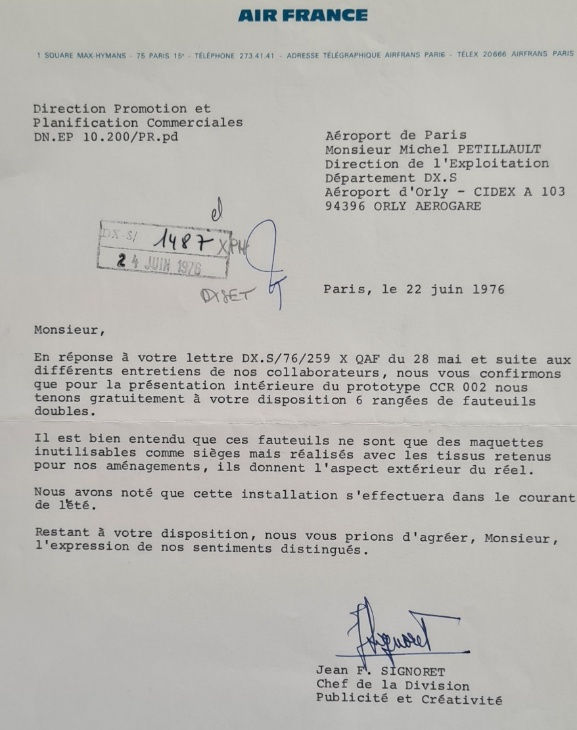
Sir,
In response to your letter DX.S/76/259 X QAF of May 28 and following various discussions with our staff, we confirm that for the interior presentation of the CCR 002 prototype, we have 6 rows of seats available to you free of charge. It is understood that these seats are only mock-ups, unusable as actual seats, but made with the fabrics selected for our interior fittings, they give the exterior appearance of the real thing. of summer.
We have noted that this installation will take place during the current period.
Remaining at your disposal, we ask you to accept, Sir, the expression of our distinguished sentiments.
Following the layout plan you saw in the previous article, the following plan provides a full explanation of the work that will be carried out by SNIAS* before the aircraft is moved to its final location at Parking P7, which will be the SA's new home for approximately ten years.

Following the nomenclature on the plan above, you can see the intervention zones and the work that the SNIAS** team will carry out.


The three columns that we will detail below and show when this is possible and/or visible on the SA now.
First, the small circle marker with the number on the overall plan.
The number of pieces produced.
The designation of the assembly.
1 - 2 - Corset au train principal
1 - 2 - Corset to the main landing gear
2 – 1 - Corset train avant
2 – 1 - Front train corset
3 - 4 - Obturateurs entrée d’air
3 - 4 - Air intake shutters
4 - 4 - Obturateurs au tuyères secondaire
4 - 4 - Shutters at secondary nozzles
5 - 1 - Bielle supérieure gouvernail
5 - 1 - Upper rudder connecting rod
6 - 2 - Bielle élevons n° 1 - 2
7 - 2 - Bielle élevons n° 3 – 4
8 - 2 - Bielle élevons n° 5 – 6
6 - 2 - Connecting rod, elevators #1 - 2
7 - 2 - Connecting rod, elevators #3 – 4
8 - 2 - Connecting rod, elevators #5 – 6
9 - 1 - Bielle inferieure gouvernail
9 - 1 - Lower rudder connecting rod
10 - 4 - Fausse bielle moteur de dump
10 - 4 - Dummy connecting rod for dump doors
11 - 1 - Amarrage au train avant
11 - 1 - Attachment to nose landing gear
12 - 2 – Cales aux trains principaux
12 - 2 – Main Lnding Gears Blokers
13 - 43 - Obturateurs circuit carburant
13 - 43 - Fuel circuit shutters in the various propulsion and fuselage parts.
14 - 133 - Maquette équipements codes dans le poste
14 - 133 - Model equipment codes in the pilote station...
15 - X – Faux clapet
15 - X – False flap
16 - 2 – Plaque d’obturation d’air basse vitesse (interne)
16 - 2 – Low-speed air sealing plate (internal)
17 - 2 – Plaque d’obturation d’air basse vitesse (externe)
17 - 2 – Low-speed air shut-off plate (external)
18 - 4 – Fausse bielles volet d’air additionnel
18 - 4 – Dummy connecting rods for additional air flap
Shown above are the Concorde seats offered in the letter from Mr. Signoret of Air France, which are still on display in the rear cabin of the aircraft.
After its somewhat bumpy landing on arrival at Orly, the plane joined the DM-AF where the work and all the modifications will be carried out.
The crew cuts off the engines and takes leave of the controllers. SA has just arrived at its last stop, Orly, where Mr. DETERVILLE is waiting for them.
This is where the last major project for the SA will begin:

- Engine dismantling,
in this photo by Jacques Guillem (taken on May 21, 1976), you can see the technicians about to begin the dismantling, and on the wing, the tools that will be used to remove the engines.

- dismantling of equipment and replacement of dismantled equipment which we will present in pictures the elements visible today in the SA in our next article.
The painting was indeed carried out by Air France, as confirmed by this fine photo taken by Jacques Guillem as the aircraft emerged from the DM paint hangar, prior to being towed to the P7 area.

* SNIAS Société Nationales des Industries Aérospatiales
To be continued…


Commentaires